


Product overview
What is Millis AI?
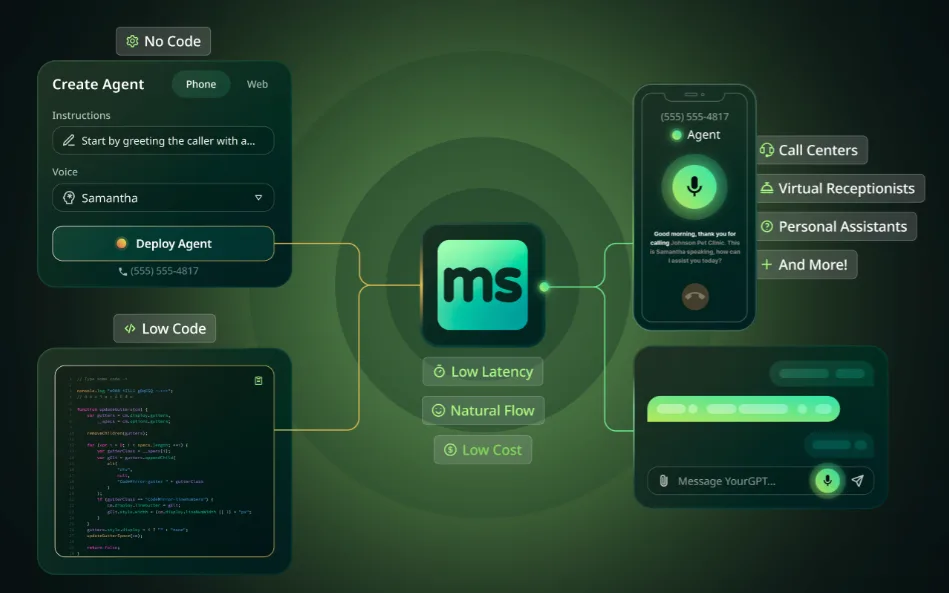
Millis AI is a platform for building low-latency, natural-sounding voice agents. Non-technical users can configure an agent with prompts, while developers can use APIs, WebSocket, WebRTC, a web SDK, an embeddable call widget, webhooks, custom LLMs, SIP trunking, and inbound or outbound telephony.
The platform separates orchestration from model, speech-to-text, text-to-speech, and phone services. This gives builders provider choices but also means total call cost is the sum of several usage components. Millis advertises roughly 600 ms conversational latency, interruption handling, intent recognition, many supported languages, and phone connectivity in more than 100 countries.
How to Use Millis AI
- Define the call purpose, permitted actions, required disclosures, handoff rules, and measurable success criteria.
- Create an agent with a clear system prompt, selected model, voice, language, and knowledge.
- Add approved functions and webhooks for calendars, CRM, support, or internal APIs.
- Choose browser, app, SIP, or phone deployment and configure inbound or outbound calling.
- Test accents, interruptions, silence, voicemail, tool failures, unsafe requests, latency, and human transfer.
- Launch with limited traffic and monitor transcripts, outcomes, cost, errors, and complaints.
- Protect credentials and sensitive call data, then review consent, recording, retention, and regional requirements.
Core Features
- Low-latency conversations: Optimizes the voice pipeline for fast, interruptible exchanges.
- No-code and developer setup: Supports prompt-based configuration plus APIs and SDKs.
- Telephony: Connects phone numbers for inbound and outbound calls across many countries.
- Web and native channels: Offers Web SDK, WebSocket, WebRTC, and an embeddable call widget.
- Functions and webhooks: Lets an agent call calendars, CRM, SaaS, and custom APIs.
- Provider flexibility: Supports platform-selected models, custom LLMs, and multiple speech providers.
- Session controls: Documents dynamic variables, metadata, and session continuation.
- Multilingual support: Lists more than 30 supported languages in current documentation.
Use Cases
- Provide 24/7 answers for routine customer-support questions.
- Qualify leads, collect information, and schedule follow-up calls.
- Build a virtual receptionist that answers and routes callers.
- Conduct automated surveys and feedback collection.
- Add voice interaction to websites, native apps, devices, and kiosks.
- Connect a voice interface to internal workflows through functions and webhooks.
Pricing
Millis charges a platform base rate of $0.02 per call minute. Model tokens, text-to-speech, speech-to-text, and telephony are additional; the documentation currently lists speech-to-text at $0.0043 per minute and provider-specific model and voice rates. Estimate total cost with the exact stack and verify current rates before launch.
Frequently Asked Questions
Is the advertised latency guaranteed for every call?
No. End-to-end latency varies with region, network, model, speech providers, tools, prompt size, and telephony. Test the intended stack under realistic load.
Can developers use their own model?
Yes. The documentation describes custom LLM integration, alongside models selected through the platform.
What compliance work remains with the customer?
Teams must determine lawful calling, AI disclosure, recording consent, opt-out handling, retention, regional hosting, access control, and industry-specific obligations.