


Product overview
What is Zep?
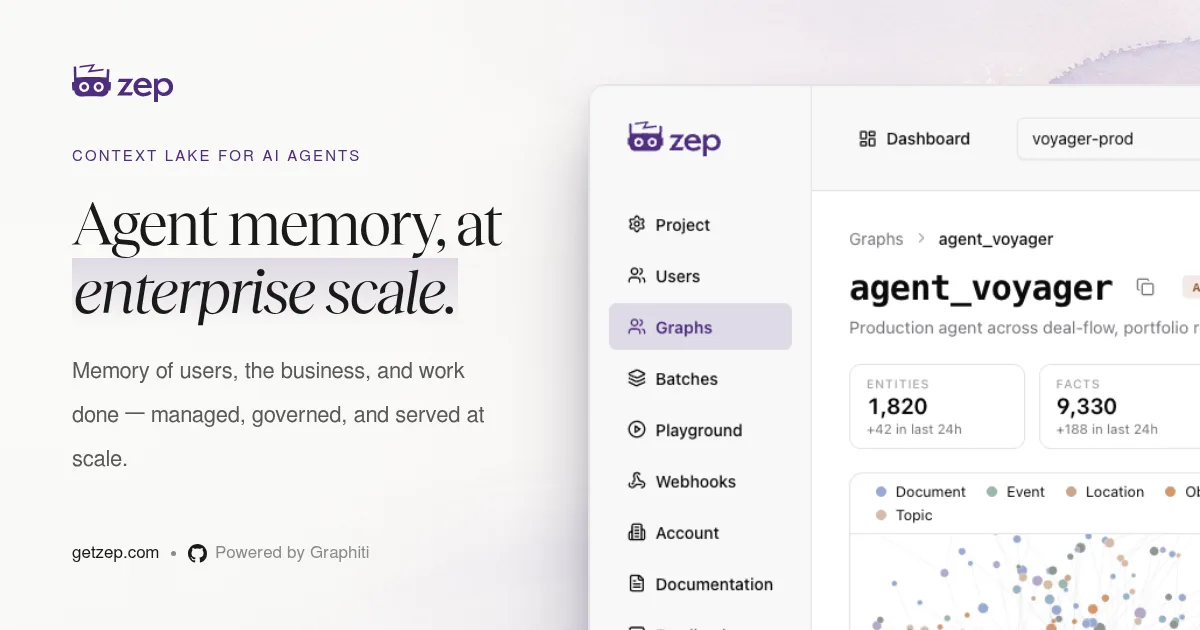
Zep is enterprise memory infrastructure for AI agents. It turns chat history, business data, and user interactions into temporal context graphs, then retrieves relevant, token-efficient context for an agent. Its memory model tracks how facts change over time instead of treating every stored fact as permanently current.
For organizations operating many agents and context sources, Zep combines these graphs in a governed Context Lake. Authorization, retention rules, provenance, and audits are applied at the context layer. The platform also exposes observability for latency, errors, retrieval activity, and ingestion throughput.
How to Use Zep
- Add messages to a thread and request the assembled context in the same API operation.
- Add structured business data to a user's graph when the agent needs context beyond conversation history.
- Retrieve the user's relevant context for the active thread and provide it to the agent.
- Apply access, retention, and audit policies to govern which context agents can use.
- Monitor graph creation, ingestion, retrieval, latency, and reliability through the built-in analytics views.
Core Features
- Temporal context graphs: Stores entities and facts with time awareness, invalidating an old fact when newer information contradicts it while retaining historical state.
- Context Lake: Manages millions of context graphs as one governed system for enterprise agent context.
- Fast context retrieval: The website reports retrieval below 200 milliseconds across the graph sizes shown on its homepage.
- Provenance: Keeps each graph fact connected to the source episode so teams can trace the context behind an answer.
- Governance: Provides attribute-based access control, policy-driven retention, legal hold, and audit and API logs.
- Deployment choices: Offers managed Cloud, managed Cloud with customer-controlled encryption keys, and deployment inside the customer's VPC.
Use Cases
- Personalized agents: Product teams preserve changing user preferences, decisions, and behavior across conversations.
- Business-aware assistants: Agents combine conversation history with structured operational data before responding or taking action.
- Long-running workflows: Agent systems retain relevant work history and retrieve current facts without sending an entire history to the model.
- Governed enterprise agents: Security and compliance teams restrict context access, set retention policies, and audit policy decisions.
- Agent observability: Platform teams monitor context ingestion and retrieval performance across projects.
Frequently Asked Questions
Does Zep work with a specific agent framework?
No specific framework is required. The website states that Zep works with any agent framework or with no framework.
How does Zep handle facts that change?
When new information contradicts an existing fact, Zep invalidates the old fact for current reasoning but preserves it as history, allowing queries about present or past state.
Where can Zep be deployed?
Zep lists managed Cloud, Cloud with customer-owned encryption keys, and Bring Your Own Cloud deployment inside a customer VPC.


