


Product overview
What is Portkey?
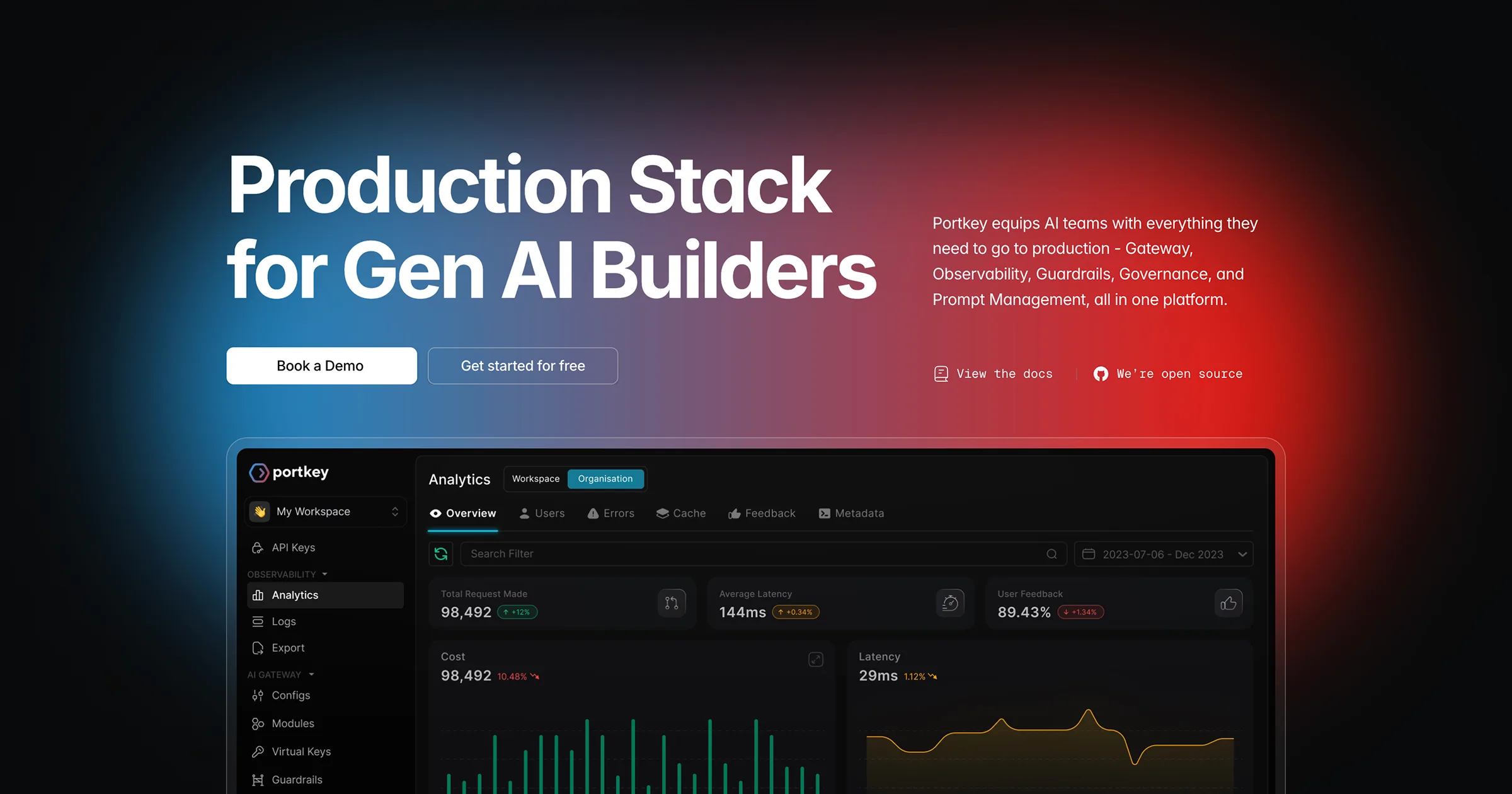
Portkey is a production stack for teams building generative AI applications and agents. It combines an AI gateway, real-time observability, guardrails, governance, prompt management, and model access in one platform. The website states that Portkey is now part of Palo Alto Networks following a completed acquisition.
The AI Gateway provides a unified API for more than 1,600 language models, reducing the need to maintain separate provider integrations. Teams can monitor model behavior and usage, apply output controls, manage prompts outside application code, and build production agent workflows. A separate MCP Gateway centralizes authentication, access, and observability for Model Context Protocol servers.
How to Use Portkey
- Create a Portkey account or use the open-source project.
- Add the Portkey client or gateway configuration to the application.
- Select a supported model through the unified API.
- Configure routing, prompts, guardrails, access policies, and caching for the workload.
- Monitor requests, model behavior, usage, anomalies, and costs through observability tools.
- Connect MCP servers through the MCP Gateway when centralized tool access is required.
Core Features
- AI Gateway: Provides one API for routing requests across more than 1,600 models.
- Observability: Monitors LLM behavior, anomalies, usage, logs, and operational metrics.
- Guardrails: Applies controls to model inputs and outputs in production workflows.
- Prompt management: Stores and changes prompts without hard-coding every version in the application.
- AI governance: Centralizes organizational policies and control over AI usage.
- MCP Gateway: Manages authentication, access, and observability for MCP servers.
Use Cases
- Multi-model applications: Change or route model providers through a unified integration.
- Production monitoring: Investigate failures, usage changes, and anomalous model behavior.
- Enterprise AI governance: Apply shared policies and access controls across teams.
- Agent infrastructure: Run model and tool calls with observability and guardrails.
- MCP security: Control which users and applications can access connected MCP tools.
Pricing
The website provides a free starting option and identifies the project as open source.
Frequently Asked Questions
How many models can Portkey access?
The homepage states that the unified API provides access to more than 1,600 language models.
Is Portkey open source?
Yes. The homepage identifies Portkey as open source.
What does the MCP Gateway manage?
It centralizes authentication, access control, and observability for MCP servers.
Who owns Portkey?
The website announces that Palo Alto Networks has completed its acquisition of Portkey.