


Product overview
What is Pecan AI?
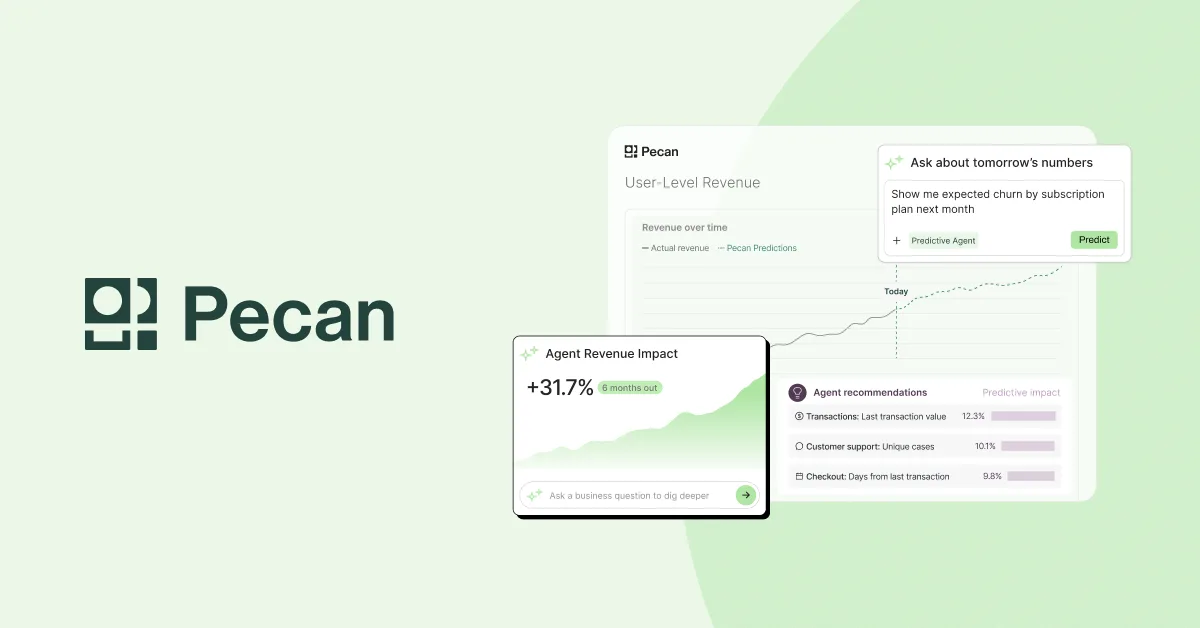
Pecan AI is a no-code predictive analytics platform for business teams, data leaders, and BI analysts. Users ask a future-facing business question, and its predictive agent prepares historical data, defines the prediction target, builds and validates a model, generates scores or forecasts, and explains the results conversationally.
The platform connects to cloud data warehouses or accepts file uploads, then delivers predictions to databases, warehouses, CRM systems, marketing tools, and BI dashboards. It targets operational decisions such as churn, lifetime value, lead conversion, demand, win-back, fraud, chargebacks, and campaign return rather than general-purpose text generation.
How to Use Pecan AI
- Define a decision that can change based on a prediction, its target, horizon, entity, and action owner.
- Confirm that sufficient historical event-level data and known outcomes exist without unnecessary PII.
- Connect an approved warehouse or upload a representative CSV or Excel dataset.
- Ask the business question and inspect automated preparation, target definition, leakage risks, and validation setup.
- Review AUC, lift, forecast error, calibration, key drivers, segments, and operational thresholds with a qualified analyst.
- Deliver predictions to the system where teams act, then run a controlled intervention or holdout test.
- Monitor drift, false positives, business impact, fairness, and retraining before scaling decisions.
Core Features
- Conversational predictive agent: Turns plain-language business questions into modeling workflows.
- Automated data preparation: Handles feature preparation and model-ready transformations.
- Model building and validation: Trains models and reports predictive performance metrics.
- Prediction delivery: Sends results to warehouses, databases, CRM, marketing, and BI workflows.
- Prediction monitoring: Tracks training and scoring progress and supports alerts.
- Data connectors: Integrates with major cloud warehouses and file uploads.
- Explainability: Shows prediction drivers and lets users explore results through questions.
- No-code workflow: Enables analysts and business teams to build predictions without ML programming.
Use Cases
- Identify customers at risk of churn for targeted retention.
- Estimate customer lifetime value and prioritize high-value cohorts.
- Score leads by their likelihood to convert.
- Forecast demand, inventory, or sales from historical patterns.
- Identify win-back, upsell, and cross-sell opportunities.
- Score fraud or chargeback risk and predict campaign ROAS.
Pricing
Pecan offers Starter, Team, and Business plans through sales rather than publishing dollar amounts. Current plan limits list 2, 10, and custom monthly prediction batches, with storage of 500 million, 2 billion, and 5 billion rows respectively. Plans are described as commitment-free with no setup fee. Confirm the tailored quote and limits before purchase.
Frequently Asked Questions
Does no-code mean no statistical review is needed?
No. Teams still need to check target leakage, sample bias, metrics, calibration, drift, fairness, causal assumptions, and whether the prediction improves a real decision.
Is personal data required?
Pecan states that PII is not required. Use the minimum approved data and confirm privacy, security, retention, and lawful-use requirements.
Are predictions the same as guaranteed outcomes?
No. Scores and forecasts express uncertainty based on past data. Monitor errors and keep human or policy controls for high-impact decisions.