Product overview
What is CAMEL-AI?
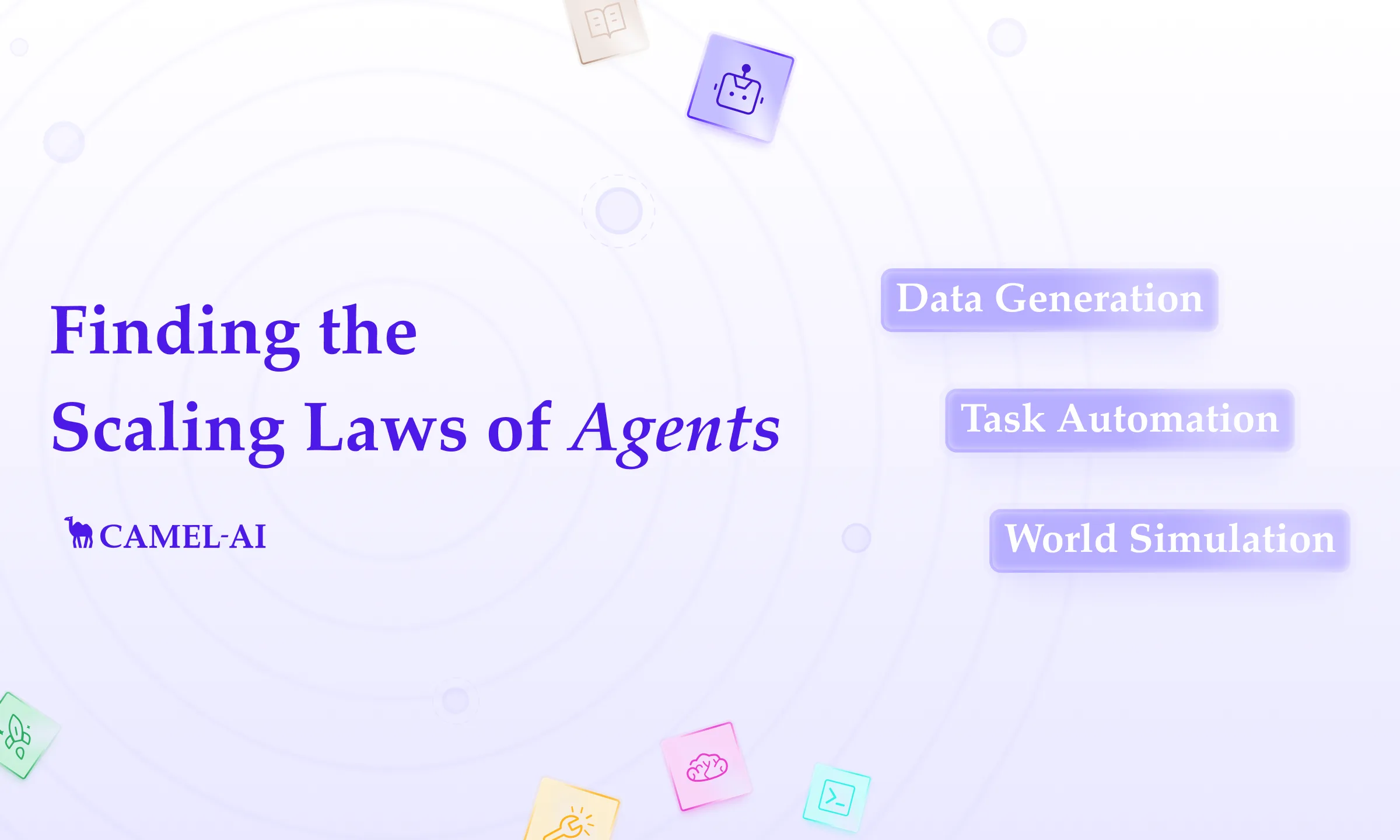
CAMEL-AI is an open-source framework and research community focused on intelligent agents and multi-agent systems. Its goal is to study how agent behavior, capabilities, and risks change at scale while providing developers and researchers with components for building agent applications. The framework covers single agents, role-playing societies, workforces, data generation, simulations, evaluation, tools, memory, storage, retrieval, runtimes, and human-in-the-loop operation.
The project organizes its design around evolvability, scalability, statefulness, and code-as-prompt. Agents can learn from generated data and environment interactions, systems can coordinate large numbers of agents, context can be managed as changing state, and code or comments can be interpreted and extended by both people and agents. The ecosystem also includes research projects and environments such as CAMEL, Workforce, OASIS, SETA, OWL, CRAB, and LOONG.
Core Features
- Agent classes: Provides single-agent implementations for conversation, planning, reasoning, tasks, repositories, knowledge graphs, search, and other roles.
- Multi-agent societies: Supports role-playing systems and workforces with roles, hierarchies, coordination, and long-horizon tasks.
- Agent toolkit: Includes messaging, planning, evaluation, observability, tool use, and human-in-the-loop components.
- State and memory: Manages conversation history, contextual blocks, vector memory, key-value storage, and other state mechanisms.
- Data and learning pipelines: Supports synthetic-data generation, self-improving pipelines, reinforcement learning, and fine-tuning workflows.
- Broad model and tool ecosystem: Connects many model providers, storage systems, retrievers, runtimes, data loaders, and MCP tools.
Use Cases
- Agent workforce development: Engineering teams can create coordinated agents with distinct roles for long-running tasks.
- Synthetic data generation: Researchers can generate conversations and reasoning data for training and evaluation.
- Social and world simulation: Teams can study large-scale agent interactions in simulated environments.
- Agent benchmarking: Researchers can evaluate multimodal, cross-environment, or trust-related agent behavior.
- Production agent applications: Developers can combine models, tools, memory, storage, retrieval, and runtimes into domain-specific systems.
Frequently Asked Questions
Is CAMEL-AI open source?
Yes. The official site describes CAMEL-AI as an open-source community and links to its framework and research repositories.
Does CAMEL-AI support multi-agent systems?
Yes. Multi-agent research and scalable agent societies are central to the project, including role-playing and workforce components.
Can CAMEL-AI connect to different models and tools?
Yes. The published technology stack includes many model providers, tools, storage systems, retrievers, runtimes, and MCP integrations.