

Product overview
What is Agentset?
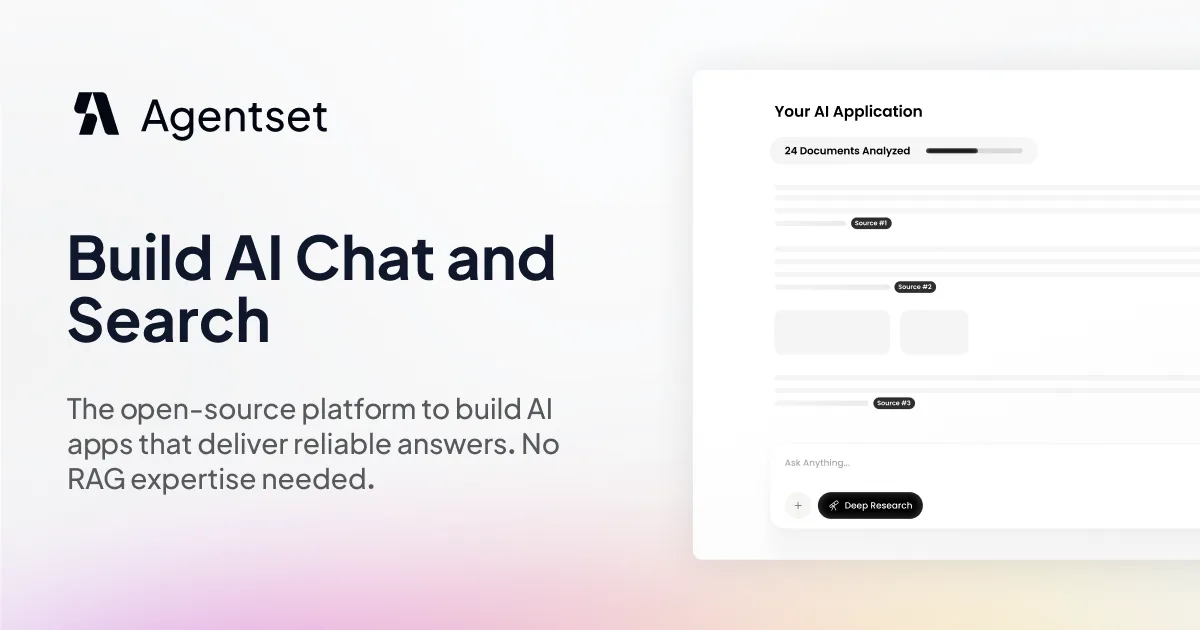
Agentset is infrastructure for developers building production-ready retrieval-augmented generation applications. It powers search and question-answering experiences inside software products without requiring teams to build and maintain an entire ingestion and retrieval pipeline. The platform is designed to keep answers reliable as document volume, usage, and query complexity grow.
Agentset works with text as well as images, graphs, and tables. It supports more than 22 file formats, metadata filters, hybrid search, reranking, agentic reasoning, and automatic citations that let users inspect answer sources. Developers can upload data and query a namespace through JavaScript or Python SDKs, connect a knowledge base to external applications through an MCP server, or integrate Agentset with the AI SDK.
The platform is model-agnostic: teams can select their vector database, embedding model, and LLM. The website lists providers and systems including OpenAI, Anthropic, Google AI, Azure, Cohere, Pinecone, Qdrant, Mistral, DeepSeek, and others.
How to Use Agentset
- Create an Agentset account and initialize the JavaScript or Python SDK with an API key.
- Select or create a namespace for the application's knowledge base.
- Create an ingestion job for a supported file and attach any metadata needed for filtering.
- Use the namespace's search or chat interface to retrieve information and produce source-backed answers.
- Connect the resulting experience to an application through the SDK, AI SDK integration, or MCP server.
Core Features
- Multimodal retrieval: Searches information contained in text, images, graphs, and tables.
- Source citations: Automatically attaches sources to answers so users can inspect the supporting material.
- Metadata filtering: Restricts retrieval to a relevant subset of uploaded data.
- Broad file support: JavaScript and Python SDKs ingest more than 22 document and data formats.
- Model-agnostic stack: Allows teams to choose their LLM, embedding model, and vector database.
- Production retrieval pipeline: Combines ingestion, chunking, hybrid search, reranking, and agentic reasoning in one system.
Use Cases
- In-product knowledge search: Software teams add search and Q&A to products backed by their own documents.
- Large-document collections: Organizations retrieve answers from legal, municipal, research, or other extensive corpora.
- Multimodal knowledge bases: Teams query documents whose useful information appears in tables, charts, or images as well as text.
- External agent access: Developers expose a knowledge base to compatible applications through Agentset's MCP server.
Frequently Asked Questions
Who is Agentset for?
It is built for developers and engineering teams creating production search or question-answering applications over their own data.
Does Agentset provide citations?
Yes. The website says it automatically cites answer sources so users can inspect them.
Can teams choose their own models and vector database?
Yes. Agentset describes its stack as model-agnostic and supports selecting the LLM, embedding model, and vector database.
What types of content can Agentset process?
It supports more than 22 file formats and can work with text, images, graphs, and tables.